

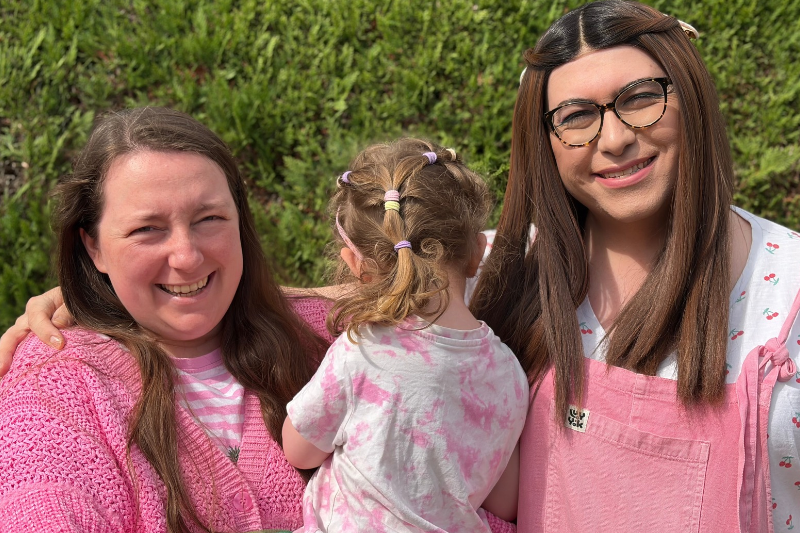
When Emma and Dani were first introduced to Home-Start Cambridgeshire, life felt overwhelming. Their three-year-old daughter was beginning the process of being assessed for autism, and they both felt as though the family were constantly battling to have their concerns heard and understood. At the same time, Emma was also awaiting her own autism diagnosis, and managing chronic health conditions including fibromyalgia and endometriosis, which often left her exhausted and in pain.
Emma was especially reluctant to accept support.
“I remember feeling completely lost,” she says. “There were so many different things going on that I didn’t know where to start. My home is my safe space, so the idea of having somebody visit every week felt really daunting.”
After several recommendations from professionals, Emma eventually agreed to try Home-Start. That decision proved life changing. The family were matched with home visiting volunteer Laurie. What Emma expected was practical advice about parenting and preparing their daughter for preschool. What she found was something much more valuable.
“Very quickly I realised nobody was there to judge us,” Emma says. “For so long we’d felt like we had to fight to explain our daughter’s needs. Having someone simply listen and say, ‘Your experience is real’, was incredibly powerful.”
The family received support just before Christmas. Then, only weeks later, everything changed. Over the festive period, Dani began her transition and started living openly as a woman. At the same time, Emma received her own autism diagnosis, followed just two weeks later by their daughter’s diagnosis.
“It was an enormous amount for all of us to process,” Emma says. “Looking back now, it feels incredible that Home-Start arrived when it did.”
For Dani also, the timing could not have been more important.
“When I began my transition, I genuinely didn’t know how people would react,” she explains. “As a trans woman, there are times when you don’t know whether support services will feel welcoming or whether you’ll have to explain and justify who you are.”
Those fears quickly disappeared.
“Laurie met me before my transition and then came back afterwards to find I was now living openly as a woman. Her response was simply kindness. She asked what pronouns I was using and carried on treating us exactly as she always had.”
For Dani, that acceptance was hugely reassuring.
“Everyone we met was respectful, supportive and genuinely interested in helping our family. We weren’t treated as a ‘different’ family. We were just a family who needed support.”
Laurie’s weekly visits became an anchor for Emma.
Before Home-Start, she regularly experienced what she called the “Sunday night scaries”, worrying about how she would manage another day alone caring for a lively three-year-old. “Once Laurie started visiting on Monday mornings, those feelings disappeared,” Emma says. “For two hours every week, I knew I wasn’t doing it all on my own.”
The visits centred around play, helping their daughter build confidence and preparing for preschool but they offered much more than practical activities and school readiness. Laurie became a listening ear, a source of reassurance and someone who understood many of the challenges involved in raising a neurodivergent child.
“The support wasn’t about someone telling us how to parent,” Emma explains. “It was about helping us recognise that we were already doing a good job. She helped us trust our instincts and feel confident asking for support when we needed it.”
The family also benefited from parent-child relationship sessions, helping strengthen the bond between Dani and their daughter during a period of significant change.
Over time, Emma noticed her confidence growing. She felt more able to advocate for her daughter, ask for school support and navigate the future with greater certainty.
For Dani, there was another reason for wanting to share their story.
“Families come in all shapes and sizes. Ours just happens to include a trans parent, neurodivergent parents and a neurodivergent child. The support we received showed us that Home-Start sees families as families. I’m proud to be a trans woman, and I’m proud of our family,” she says. “If another family is sitting where we were a year ago, feeling overwhelmed or wondering whether Home-Start is for people like them, I want them to know that it is. And, if sharing our story helps another family take that first step and ask for support, then it will have been worth it.”
Today, as their daughter prepares to start preschool, Emma and Dani feel more ready for whatever comes next. “There will always be challenges,” Emma says. “Parenting doesn’t suddenly become easy. But we feel more confident, more prepared and much less alone.”
Reflecting on their journey, Dani said, “We felt like we had someone on our team.”
And for Emma, Home-Start’s support can be summed up in a single sentence she wrote in a card to Laurie at the end of their time together:
“It was exactly what we needed, exactly when we needed it.”